Sixi Assure
Know who owns every AI agent before the people who built it leave.
AI agents are often built by a vendor or by contractors. When they leave, the diagrams stay, but the knowledge of who owns what goes with them. Sixi Assure turns the design of your agent system into a model you can question, and into evidence that your risk, audit and platform teams can read.
See it in 81 seconds
The handover scene on the demo design, with made-up names.
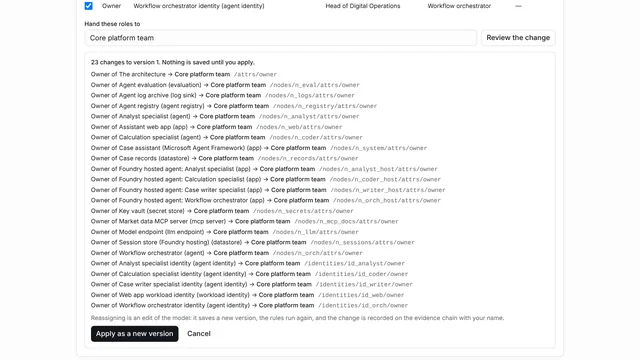
What the recording shows: where the design stands, which roles a vendor holds and where nobody else is named, the reviewed change that hands those roles to the team that stays, the agent passports and the handover pack. It has captions and no sound.
What you get
Your agent system as one model
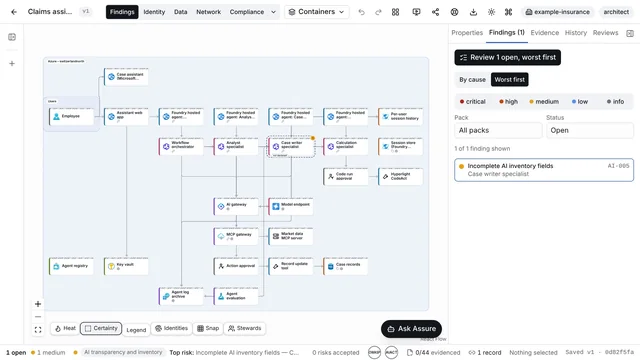
Agents, identities, tools, data stores and the connections between them in one typed model, started from the diagrams you already have.
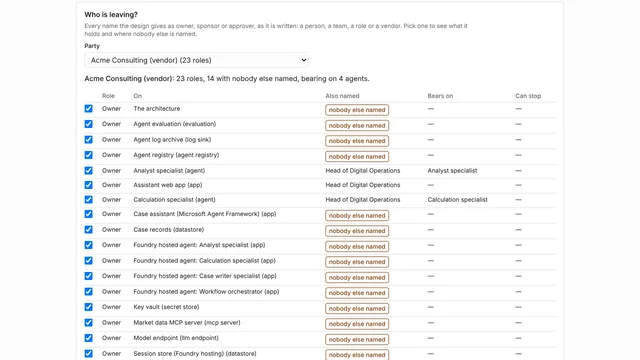
Who is leaving?
Pick a person, a team or a vendor and see every role it holds, and where nobody else is named.
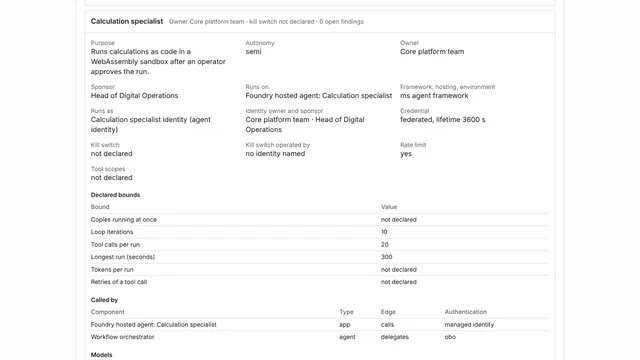
A passport for every agent
Purpose, owner, sponsor, identity, credential, tools, limits and how the agent is stopped, on one page. What the design does not say is shown as not declared, never guessed.
Findings that cite their clause
Deterministic rules produce the findings. Each one names the clause it rests on, or says that no clause was found.
The rules draw on clauses of, among others:
- EU AI Act
- DORA
- FINMA
- GDPR
- Swiss FADP
- NIS2
- ISO
- NIST
- OWASP
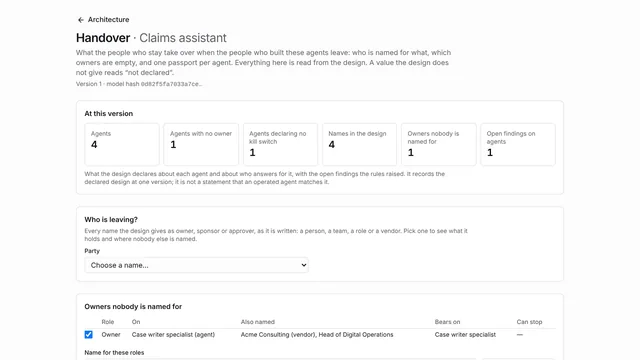
Changes that a person accepts
Handing roles to the team that stays is a change to the model. Every change is listed before anything is saved, and its acceptance is recorded as evidence.
A signed handover pack
The roster, the passports, the findings and the record of changes in one pack, signed so that a later reader can check that nothing was altered.
Three ways to get it
Agent Handover Review
One system with agents, up to 60 components. You bring the diagrams you have and join 2 workshops of 60 minutes each. Within 2 weeks you hold the model, the roster, a passport for every agent, the findings with their clauses, the signed pack and a readout.
As a service
The lab runs Sixi Assure for you: a workspace for your team, set up for pilot customers by arrangement.
In your own environment
Sixi Assure runs in containers. For teams whose designs must not leave their network, it can be installed in your own cloud or data centre by arrangement.
What it is not
- It assesses and evidences. It does not certify compliance, and it is not legal advice.
- Rules decide. The language model explains and proposes, and never states that something complies.
- It works on the design. It does not scan or reach your running systems, and it records security properties of connections, never keys or certificates.
- Nothing changes on its own: a person accepts every proposed change, and the acceptance is recorded.
Tell me what you are building.
We start with a call of 30 minutes: what the system does, what it touches and what could go wrong. Then you get a fixed-scope proposal.